


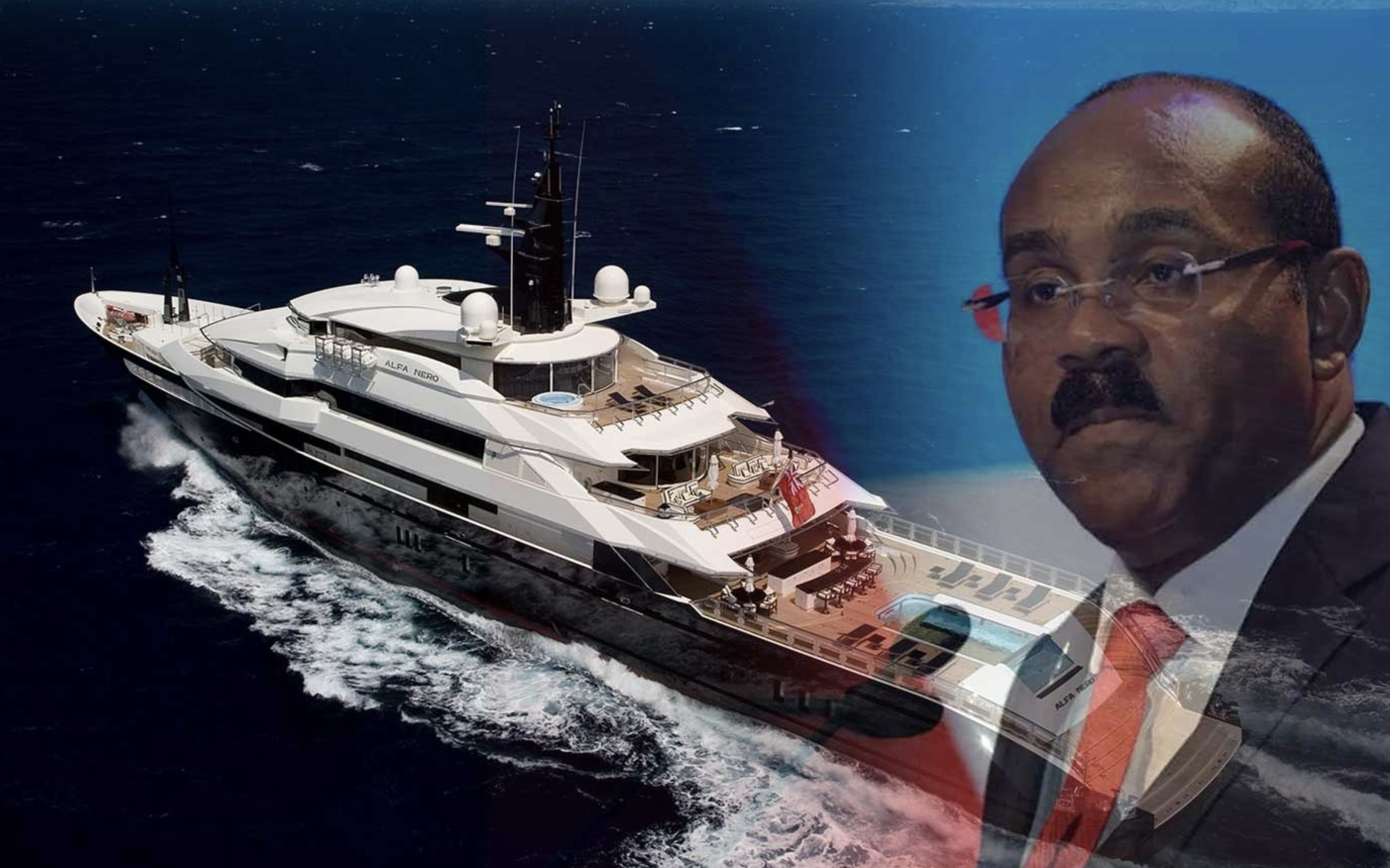
“The prime minister’s own lawyers may have inadvertently exposed his finances to judicial scrutiny in the case of the purloined superyacht” Alfa Nero, according to a National News Brief report in the U.S.
“Now, according to a newly filed memorandum in the U.S. District Court for the Southern District of New York, Browne’s own legal strategy may have dramatically expanded his opponents’ ability to obtain financial records connected to the sale,” the 30 June report says.
How?
Browne’s lawyers got him to tie the Alfa Nero case in the United States to Antigua and Barbuda law when they filed against the Boies Schiller Flexner (BSF) law firm and one of its attorneys, Martin De Luca.
When Browne’s lawyers sued the firm and De Luca for defamation in Antigua, the report says, they triggered a legal process that allows the accused to pursue discovery against Browne in Antigua and use it in the United States.
Browne’s move allows US courts ‘to compel the production of evidence’ in Antigua defamation case
BSF and De Luca “argue that a recent ruling by Antigua’s High Court fundamentally altered the legal landscape when it admitted evidence previously obtained through discovery proceedings in Florida under 28 U.S.C. Section 1782, a federal statute that allows American courts to compel the production of evidence for use in foreign litigation,” according to the report.
That means that, in order to be able to prove in Antigua that they did not defame Browne, they are entitled to look into Browne’s finances – personal and official – as part of their defense.
As such, the American courts handling the Alfa Nero case may force Browne to produce the evidence in the U.S. that he must produce in Antigua for BSF and De Luca.
Browne’s legal strategy backfired
“The irony underlying the latest filing is difficult to miss,” according to the report.
“Browne’s defamation lawsuit seeks to establish that public allegations concerning the yacht sale were false. But according to the applicants, by placing the truth of those statements squarely before the court, Browne has made the underlying financial records directly relevant to the litigation.
“Among the issues the defendants say require examination are whether the yacht was sold below market value, whether the proceeds were properly distributed, and whether any undisclosed individuals or entities benefited financially from the transaction,” the report says.
The memorandum argues that rather than narrowing the dispute, Browne’s lawsuit has actually expanded the scope of the inquest, and public interest in conducting a full and detailed examination of the sale’s financial trail.”
Litigation moves from ‘who owned the superyacht’ to ‘where the money went‘
“If the Southern District of New York grants the amended discovery request” of BSF and De Luca, the report says, “the next phase of the case may move beyond courtroom arguments and into the banking system itself. There, wire transfers, account records and financial documents could provide the clearest picture yet of what became of the approximately $40 million generated by one of the Caribbean’s most controversial government asset sales.
“The central question before the courts is no longer limited to who owned the superyacht Alfa Nero. The litigation has now become a search for where the money went.”
Browne says it’s all ‘false and misleading’
Browne immediately responded to the National News Brief report and posted a refutation the same day on his Facebook page.
“My attention has been drawn to an online article posted by an entity called National News Brief, bearing the headline ‘Antiguan Prime Minister Defamation Lawsuit Against U.S. Law Firm Backfires’. The article is currently being circulated on social media in Antigua and Barbuda and makes a series of false and misleading claims about my conduct and the Government’s handling of the sale of the superyacht Alfa Nero,” Browne said.


Leave a Reply