
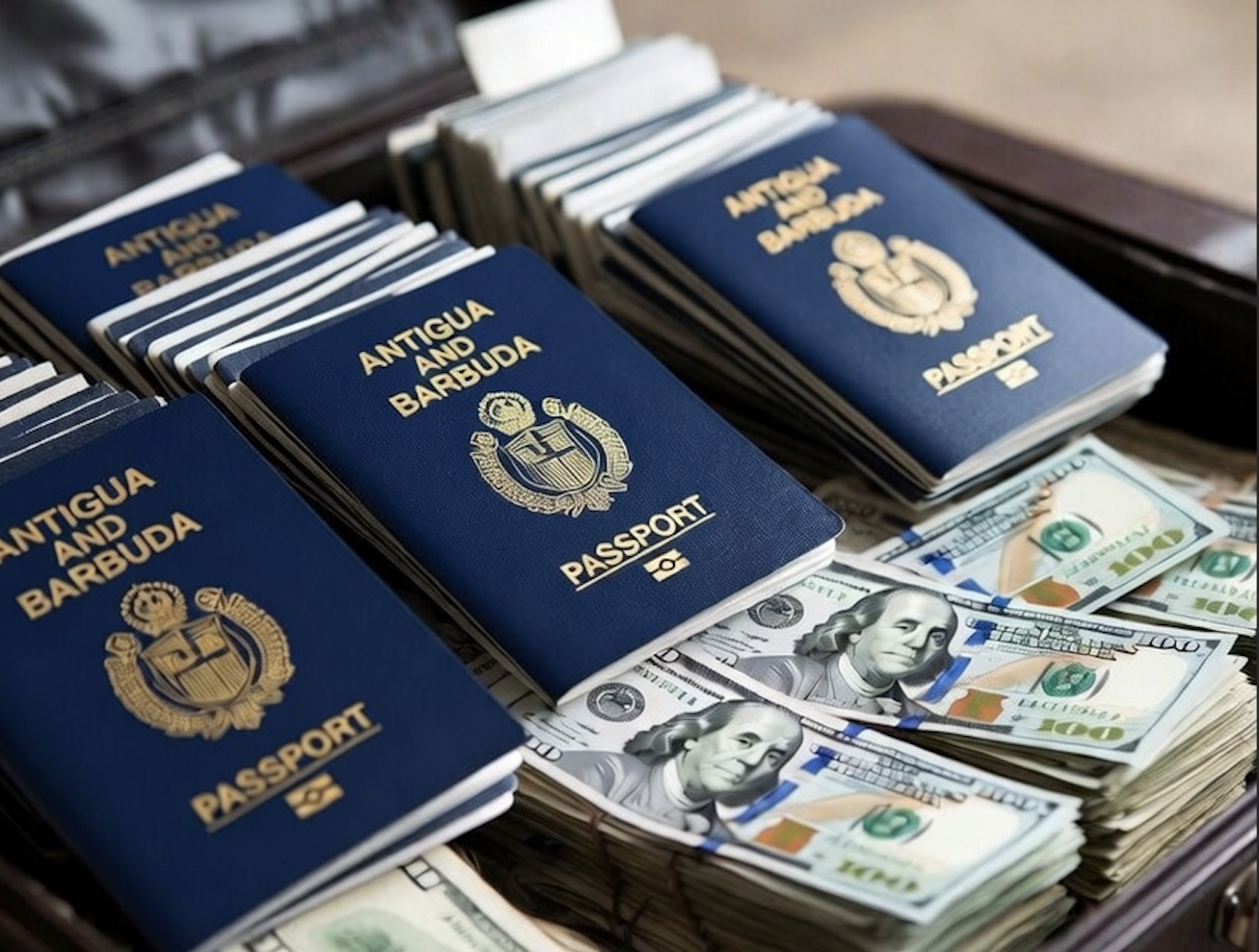

It has been more than 10 months since the US warned Gaston Browne’s government that it had to change its CIP passport policies or risk visa restrictions on our passports.
Browne has talked a lot but hasn’t done a thing.
Secretary of State Marco Rubio signed a memorandum on June 14, 2025, to his diplomats instructing them to inform certain countries, including ours, that their lax CIP policies risked American national security, and that if they wanted to avoid U.S. restrictions on their passport holders, their CIP policies would have to meet world standards.
News reports on that day named Antigua and Barbuda.
This was just weeks after Browne met with Rubio at the State Department. Caribbean newspapers reported it at the time. The U.S. gave the countries in question a 60-day window to fix the problem.
Browne pretended to the Antigua and Barbuda public that he was working at the “highest levels” to address the issue.
In fact, he did nothing.
His ambassador to Washington, Ronnie Sanders. Sanders was uncharacteristically silent.
Saint Kitts and Nevis worked quickly to correct issues pertaining to their CIP programme. But not Antigua and Barbuda.
Six months later, on December 16, Trump issued a declaration restricting foreign nationals of certain countries, including Antigua and Barbuda, because of their governments’ fraud-filled CIP policies.
Browne made a statement on December 17, acting surprised, and saying that the U.S. action was wrong.
Sanders pretended that this was all news to him.
The United States offered a 180-day review period so the Browne government could modify the policies and get the restrictions lifted. That amounts to a one-year grace period from Rubio’s June 14, 2025 memorandum.
The review period is good until July 1, 2026.
Browne still did nothing. He just pretended to work with the U.S.
Then he called snap elections before the expiration of that 180-day review period.
It’s because he will not bring our country’s CIP policy to world standards. As long as he is prime minister, Antiguans and Barbudans will be treated as suspicious characters when they travel. And many will not be able to travel at all. Because other countries, including the European Union, will soon impose their own restrictions.
Summary of what this means for Antiguans and Barbudans
- Trump Presidential Proclamation – December 16, 2025
- Presidential Proclamation 10998, “Restricting and Limiting the Entry of Foreign Nationals to Protect the Security of the United States,” singled out Caribbean citizenship‑by‑investment (CIP) states without residency requirements, including Antigua and Barbuda.
- For Antigua and Barbuda, it provides that entry to the U.S. is suspended for nationals seeking:
- Immigrant visas, and
- Non‑immigrant B‑1, B‑2, B‑1/B‑2, F, M, and J visas (tourist/business, study, vocational, and exchange programs).
- The restrictions took effect January 1, 2026, with an 180‑day review cycle – until July 1, 2026, after the snap election – for potential modification or lifting –
- Visa validity slashed from 10 years to 3 months + single entry
- In early 2026, the State Department updated the reciprocity schedule:
- B‑1/B‑2 visitor visas for Antiguan and Barbudan nationals were cut from 120‑month, multiple‑entry to 3‑month, single‑entry.
- The same 3‑month / single‑entry cap now applies to:
- Diplomatic visas (A‑1, A‑2, G‑series) remain at 60‑month, multiple‑entry.
- In early 2026, the State Department updated the reciprocity schedule:
- New bond requirement for many visitor visas
- Existing visas grandfathered
- Ronald Sanders, Antigua and Barbuda’s ambassador to the U.S., announced that Washington agreed existing U.S. visas issued to Antiguan and Barbudan nationals up to 31 December 2025 will remain valid and will not be revoked. (It wasn’t because of anything Sanders did. Trump had already included the provision in his earlier executive order.)
- New applications after that date fall under the new restrictions and reciprocity terms.
2. Main domestic controversies and political arguments
2.1. U.S. placed blame on CIP and government due diligence
- U.S. rationale
- The proclamation and follow‑up commentary explicitly tie the new restrictions to concerns about CIP programmes “without residency requirements” and weak vetting.
- The June 2025 State Department memo reportedly warned four Caribbean CIP jurisdictions (including Antigua & Barbuda) that they could face travel restrictions if they did not strengthen passport vetting and residency rules.
- Local criticism
- Critics and investment‑migration analysts argue that Antigua’s failure to move fast enough on reforms (e.g., residency, biometric capture, information‑sharing) triggered the U.S. response, and that ordinary citizens are paying the price for CIP policy choices.
- Commentary aimed at the regional policy community notes that Saint Kitts and Nevis tightened residency rules and avoided the same degree of sanction, while Antigua was still “considering” extending its 30‑day/5‑year physical presence requirement to 90 days.
2.2. Accusations that the government “downplayed” or misrepresented the impact
- Messaging vs. reality
- The Office of the Prime Minister and Antigua’s ambassador issued statements stressing that:
- Existing visas remain valid,
- Negotiations are ongoing, and
- The measures affect only a subset of new applicants and are part of a “pilot program.”
- Travel and migration outlets, as well as local talk shows, counter that this understates the severity:
- For many citizens, new tourist, business, and student visas are effectively suspended or curtailed;
- Visa validity has been dramatically shortened, and the bond requirement creates a significant financial barrier.
- The Office of the Prime Minister and Antigua’s ambassador issued statements stressing that:
- Public anger and perception of “spin”
- A popular Antigua Observer social post summed up the mood: “Antigua and Barbuda’s access to United States visas has tightened further…”, noting the shift to single‑entry, 3‑month terms.
- Opposition voices accuse the government of spinning a serious diplomatic setback as ‘technical negotiations’, saying the public deserves candour about the scale of the downgrade and its link to domestic governance issues (CIP/CBI, AML/KYC, alleged corruption).
2.3. Sovereignty vs. dependence – debate over U.S. leverage
- Government framing
- Official statements stress that Antigua and Barbuda is engaging the U.S. “respectfully and persistently” and that “outcomes in international affairs are never guaranteed”, but that they expect “reason to prevail.”
- The line is that Antigua and Barbuda is a sovereign state that will adjust technical measures (biometrics, information‑sharing) but will not allow external powers to dictate its development strategy. The U.S. respects that sovereignty, but has its own sovereignty to consider first.
- Opposition / civil society framing
- Critics argue the episode shows just how much leverage Washington has over small states: one proclamation immediately affects students, businesspeople, families, and CIP investors, underscoring Antigua’s dependency. (The critics’ arguments are false. The U.S. applies the policy to all countries with CBI.)
- They call for a fundamental reassessment of CIP and a more diversified foreign policy to reduce vulnerability to unilateral U.S. measures. (Again, a false premise. Thanks to Browne’s lax CIP rules, the EU already considers Antigua and Barbuda a high-risk jurisdiction and is poised to impose restrictions on our passport holders.)
2.4. Economic and reputational fallout for CIP and tourism
- CBI market damage
- Investment‑migration firms warn that U.S. visa suspension for key categories, combined with threatened EU/Schengen restrictions, makes an Antiguan passport significantly less attractive. This is all because of Gaston Browne’s cronyism and corruption.
- Articles aimed at investors note that “the message is clear: a passport must represent a genuine connection to a country, not just a financial transaction,” implying Antigua must harden residency and due‑diligence standards or lose its CIP business.
- Tourism vs. outbound travel
- Antigua’s tourism authority has emphasized that U.S. visitors to Antigua are unaffected—entry/exits for Americans into Antigua have not changed.
- The controversy is about Antiguans’ outbound travel to the U.S., especially for study, medical care, family visits, and business, which is politically sensitive domestically but less visible internationally.
3. Official responses and ongoing negotiations
- Government of Antigua & Barbuda
- Ambassador Ronald Sanders:
- Prime Minister Gaston Browne:
- Citizenship by Investment Unit:
- No rollback yet
- As of early 2026, observers note that despite the 180‑day review built into the proclamation, no concrete rollback has occurred for Antigua & Barbuda; visa validity and bond rules remain in place.
- This fuels domestic criticism that negotiations are either stalled or not delivering and that the government is not being transparent about progress.
Key Takeaways
- What changed:
- The U.S. has suspended or sharply curtailed new U.S. visas (B‑1/B‑2, F, M, J, and immigrant visas) for Antigua and Barbuda nationals as of January 1, 2026, slashing visa validity to 3 months, single‑entry, and imposing bonds up to $15,000 for many visitor visas.
- Existing visas issued before 31 December 2025 remain valid and are not revoked.
- Why Washington says it did this:
- Concerns over CIP programmes without residency, vetting standards, and security/identity risks tied to citizenship by investment.
- Domestic controversies:
- Government accused of:
- Failing to reform CIP in time,
- Downplaying the severity of the restrictions, and
- Leaving ordinary citizens and students to carry the cost of policy decisions.
- Government response: emphasizes diplomacy, confirms no change for existing visas, and frames changes as technical and negotiable, while critics say that’s spin that obscures a major loss of mobility and status.
- Government accused of:


Leave a Reply